Meetings
BioHackSWAT4HCLS 2026
BioHackathon Europe 2026
BioHackathon Germany 2026
DBCLS BioHackathon 2026
ELIXIR INTOXICOM
Recent preprints
-
DBCLS BioHackathon 2026 report: Mass spectrometry data analysis workflow and visualization towards trans-omics research
Public repositories for mass spectrometry (MS) data contain rapidly growing collections of proteomic, metaproteomic, and metabolomic data, but differences in analytical procedures, metadata, data formats, and visualization environments limit their reuse and integration. During BioHackathon 2026, we developed complementary components of an infrastructure for standardized reanalysis for proteomics and trans-omics applications. First, we redesigned the jPOST proteomics reanalysis workflow to improve scalability, reduce manual intervention, and facilitate consistent transfer of data and metadata among the repository, reanalysis system, and jPOSTdb. The workflow uses detailed Journal of Proteome Data and Methods (JPDM) metadata and integrates results from three search engines using UniScore. Second, we developed metaproteome visualizations that connect spectral evidence with metabolic pathways and microbial phyla, enabling functional comparison among samples and experimental groups. Third, we enhanced Mass++4, a cross-platform spectrum and chromatogram viewer, by improving its connectivity with public repositories and expanding functions relevant to the inspection of proteomic and metabolomic data. Finally, we investigated the interoperability of MB-POST with the MetabolomicsHub common data model and mzTab-M. This analysis identified requirements for controlled-vocabulary mapping, explicit representation of experimental factors and sample groups, and standardization of quantitative-result formats. Together, these developments connect raw-data preservation, standardized metadata, reproducible reanalysis, biological visualization, and cross-repository interoperability. Although further implementation and large-scale validation are required, they provide a practical foundation for integrating proteomic, metaproteomic, and metabolomic data in future trans-omics studies. -
ZebraSeek integrates complementary facial and clinical evidence for rare disease prioritization
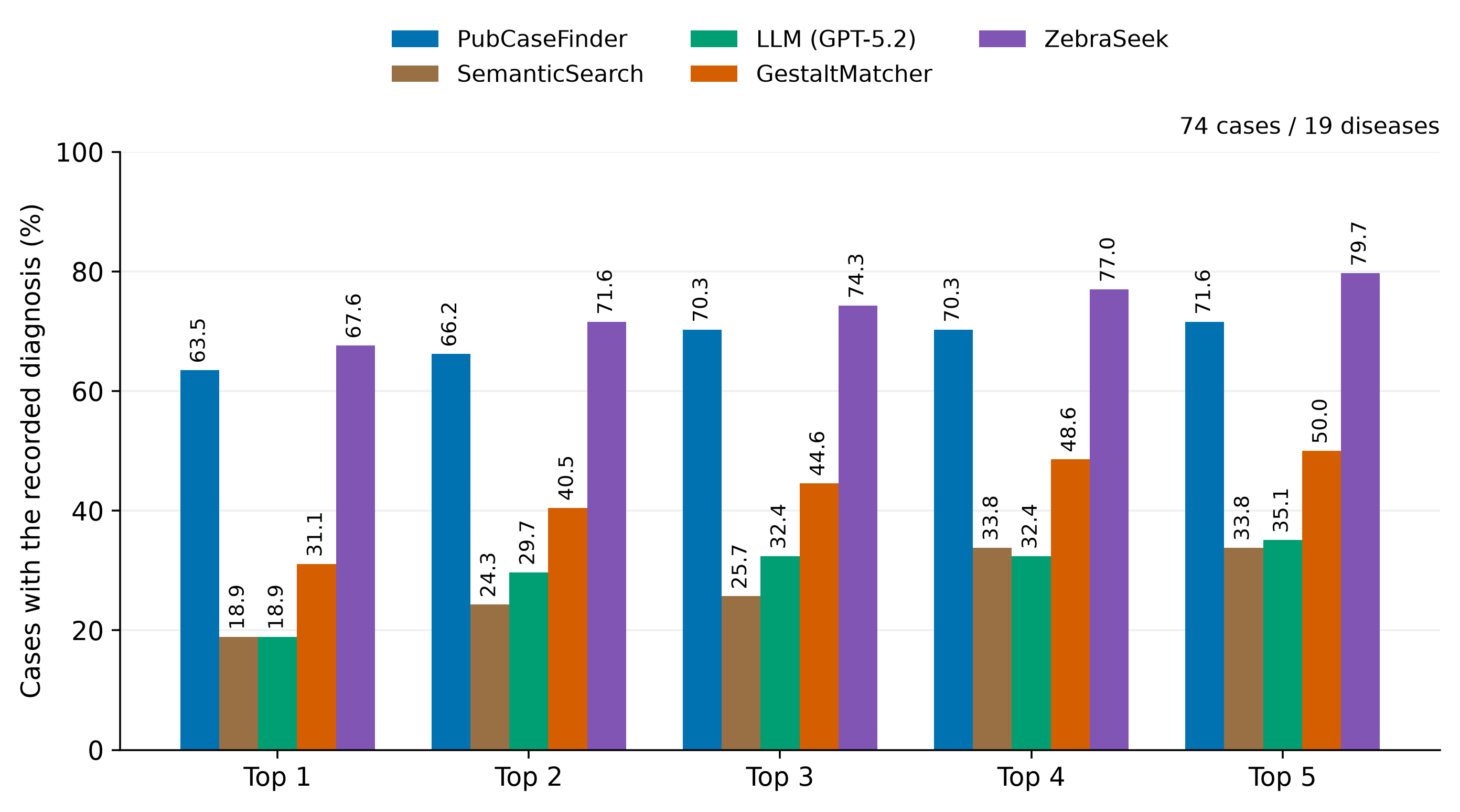
Rare diseases can remain undiagnosed for years because individual disorders are uncommon and clinically heterogeneous, while relevant clues are distributed across structured phenotypes, facial appearance, prior cases and disease knowledge. Computational tools can use Human Phenotype Ontology (HPO)-encoded findings, genomic data and increasingly diverse medical images, but these modalities are processed by models with different outputs and score scales. ZebraSeek converts clinical and facial inputs into ranked disease candidates with specialist tools, then uses a large language model (LLM) to integrateand externally check those candidates while retaining their sources. Facial-image analysis provides a complementary machine-readable phenotype that can capture patterns notfully represented by manually encoded HPO terms. In 74 literature-derived cases spanning 19 diseases, ZebraSeek placed the recorded diagnosis first in 50 (67.6%) and within five in 59 (79.7%); it recovered 11 diagnoses outside PubCaseFinder’s top five, while five diagnoses present in PubCaseFinder’s top five were absent from ZebraSeek’s final top five. During DBCLS BioHackathon 2026, we expanded analysis to 368 patients, 462 images and 54 disorders to examine how candidate depth affects coverage and downstream candidate count, and to assess the feasibility of case-specific candidate selection. -
BioHackrXiv: Hacking for better PDFs
BioHackrXiv continues to host project reports from biohackathon events (Prins et al., 2022). It has published more than 150 preprints and are indexed by Europe PMC and notable preprints are indexed by Wikidata too. It has supported multiple biohackathons, including the DBCLS BioHackathon and BioHackathon Europe series (Garcia et al., 2020). A full overview of supported meetings is available from the index.biohackrxiv.org website. The original Markdown setup with metadata in YAML headers (Perk et al., 2024) has been extended since 2020 with support for citation intent annotations with the Citation Typing Ontology (Willighagen et al., 2023), making ORCID identifiers for authors and ROR identifiers for research organizations visible in the PDFs (Willighagen & Ohta, 2025), and support for the Contributor Role Taxonomy (CRediT) annotation of author roles (McNutt et al., 2018). These things have been developed with the help of the same communities BioHackrXiv supports. -
DBCLS BioHackathon 2026 report: An interactive, harmonised BioSample metadata resource for biological sample discovery
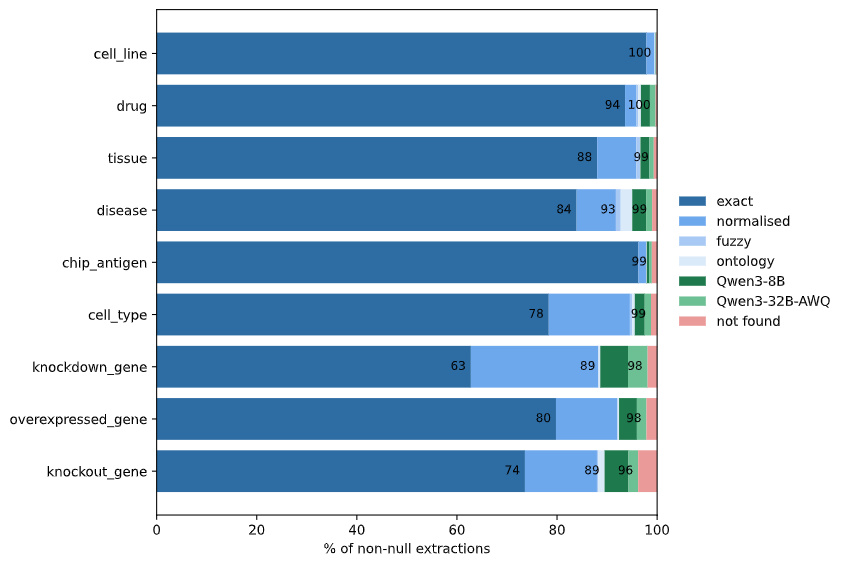
The BioSample database contains tens of millions of records describing biological samples, but their metadata are submitted largely as key-value pairs with inconsistent field names, terminology and free-text descriptions, limiting search and reuse. Before the DBCLS BioHackathon 2026, we used a pipeline based on locally hosted large language models (LLMs) to extract nine types of biological information (cell line, cell type, tissue, disease, drug, knockout gene, knockdown gene, overexpressed gene and ChIP antigen) from 4.2 million human and mouse BioSample records and map them to ontology terms, producing a harmonised collection of 8.2 million extracted values. During the BioHackathon, we extended this work in three directions. First, we developed an alpha version of a web application for searching this collection by ontology terms and visualising the experimental conditions of selected samples. Second, we developed a provenance-tracing procedure, combining deterministic matching with LLM-based checks, that linked 99% of extracted values to supporting text in the original records. The resulting provenance links showed that although 32 submitted field names accounted for 90% of the evidence, the remaining 10% was spread across more than 6,000 other field names. Third, we developed a procedure in which an LLM assesses mapping correctness and classifies the causes of errors, offering a scalable alternative to building new manually curated gold standards. Our preliminary results show the potential of locally hosted LLMs to harmonise existing BioSample metadata at scale. Future work will validate the LLM-based evaluations with human experts and extend the approach to additional species. -
DBCLS BioHackathon 2026 report: RDF publication of Marchantia polymorpha gene annotations, and agent-assisted preparation of DDBJ submissions
This report describes work carried out during the DBCLS BioHackathon 2026 (BH26) in Matsuyama, Japan, on three loosely related but complementary threads, all concerned with moving genome annotation data across the boundary between the systems that produce it and the systems that consume it. First, gene annotations of the liverwort Marchantiapolymorpha, maintained in MarpolBase, were converted to RDF: an RDF structure was designed, a converter from GFF3 was written, and the resulting graph was loaded into Virtuoso and deployed to a production endpoint. Second, a prototype agent for preparing submissions to the DNA Data Bank of Japan (DDBJ), provisionally called DFAST-Agent, was assembled from a Model Context Protocol (MCP) server and a set of skills; submission files were successfully produced through an interactive terminal session, including operations on files held in Kura, DDBJ’s authenticated object storage. Third, Markit, a tool for registering phylogenetic marker sequences, gained a webinterface that was deployed to a staging environment, alongside fixes to its command-line counterpart. Taken together, these threads probe the same question from two sides: how to make annotation data machine-actionable once it has been published, and how to lower the cost of publishing it in the first place. -
BioHackrXiv: Creating a federated publishing platform
The first BioHackrXiv preprint was published in 2020, using a platform based on the idea of using Markdown (Prins et al., 2022), and BioHackrXiv can be considered a preprint success with over 119 publications (per September 2025) with over 30 publication added per year. Machine-readable metadata is added to the Markdown that is added includes the title, keywords, the author names, their affiliations, and details about the Biohackathon event the preprint is related to. -
DBCLS BioHackathon 2026 report: Extending TogoMCP beyond RDF Portal while making its schema guides check their own answers
TogoMCP is a Model Context Protocol (MCP) server that lets large language model (LLM) agents query life-science knowledge graphs in SPARQL, guided by per-database schema documents called MIE(Metadata Interoperability Exchange) files. During the DBCLS BioHackathon 2026 (BH26), the TogoMCP group set out to extend the server, refine the MIE files, add databases, learn what makes a good SPARQL example, and turn use cases into reusable agent skills. In the first six days of the event we published eleven releases (v2.12.2 to v2.20.0) and grew the catalogue from 37 to 45 databases: Fanta.bio, WikiPathways, IDSM, PubCase Finder, LIPID MAPS, SwissLipids and MarpolBase, plus BH26Microbes, an experimental dataset of KEGG Orthology assignments for 57.6 million prokaryotic proteins built for the BioHackathon. Five of them are served from endpoints outside RDF Portal,and a sixth from a QLever engine inside it rather than Virtuoso, and they broke assumptions the rest of the corpus had taught, such as named-graph pinning, federation with SERVICE, literal typing, and even that a result set is complete. For the first time, MIE files were written by people other than the server’s maintainer, one of them by the maintainer of the database it describes, and a second group member built TogoCX, a companion MCP server that returns database edges with instructions on how their claims may be stated. We made every worked example in the MIE corpus (now 420) assert its recorded result against the live endpoint in continuous integration.The first full comparison found drift that execution-only checks had missed, most seriously a NANDO release that made an example join silently miss about 88% of mapped diseases. Onboarding the new databases uncovered a series of quantified “silent wrong answers”, queries that return plausible results rather than errors, including a category count inflated 3.1-fold by an upstream data defect and a gene enumeration that returns 10,000 of 18,080 rows without an error or awarning. We also added two PubCaseFinder tools for phenotype-driven rare-disease diagnosis support, began serving analysis workflows (agent skills) from the server, fixed failure modes found in production call logs, made TogoID errors suggest working conversion routes, and prepared a LOTUS natural-products graph for hosting on RDF Portal. We argue that for LLM-facing schema documentation, “the example still runs” is not evidence that it is still correct.