Enhancing multi-omic analyses through a federated microbiome analysis service
Multi-omics datasets are an increasingly prevalent and necessary resource for achieving scientificadvances in microbial ecosystem research. However, they present twin challenges to researchinfrastructures: firstly the utility of multi-omics datasets relies entirely on interoperability ofomics layers, i.e. on formalised data linking. Secondly, microbiome derived data typically leadto computationally expensive analyses, and so rely on the availability of high performancecomputing (HPC) or cloud infrastructures. These challenges can be better met by combining the resources of multiple groups, services and infrastructures. In this BioHackathon Europe 2024 project, we envisioned a “federated microbiome analysis service” and worked on three tracks of development towards it: mapping metagenomics metadata standards to Schema.org and Bioschemas terms, rendering Nextflow workflow executions as RO-Crates, and tooling for creating, viewing and interlinking human-readable RO-Crate previews.
Figures
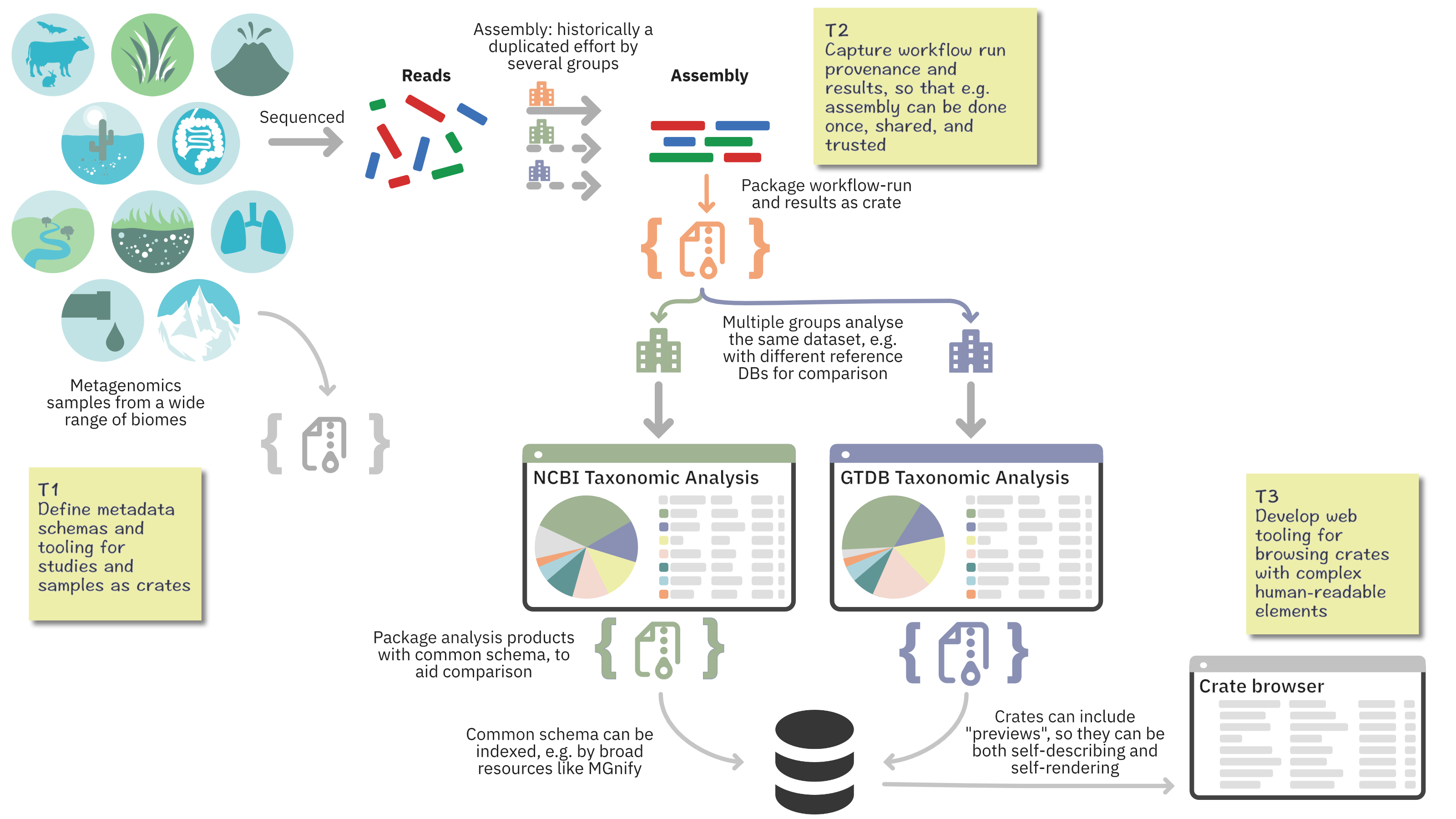
Conceptual schematic of a federated microbiome analysis service, including work done during this BioHackathon. In thi...
Conceptual schematic of a federated microbiome analysis service, including work done during this BioHackathon. In this scenario, metagenomics samples’ and studies’ metadata should be captured following a common RO-Crate profile. Pipeline processes, embedded tools, and results should be annotated so that their execution and creation provenance can be maintained. This allows, for example, for various groups to reuse assemblies whilst maintaining a chain of provenance. Analyses of metagenomics raw reads and assemblies (or metagenome-assembled genomes) should also follow a shared standard, so that downstream users, clients, and indexes can automatically understand how to index and compare these analyses from heterogeneous pipelines. Finally, metagenomic RO-Crates should make use of RO-Crate’s preview features so that they can be self-rendering: for example it should be easy to view any HTML renderings of metadata and results contained within the crate.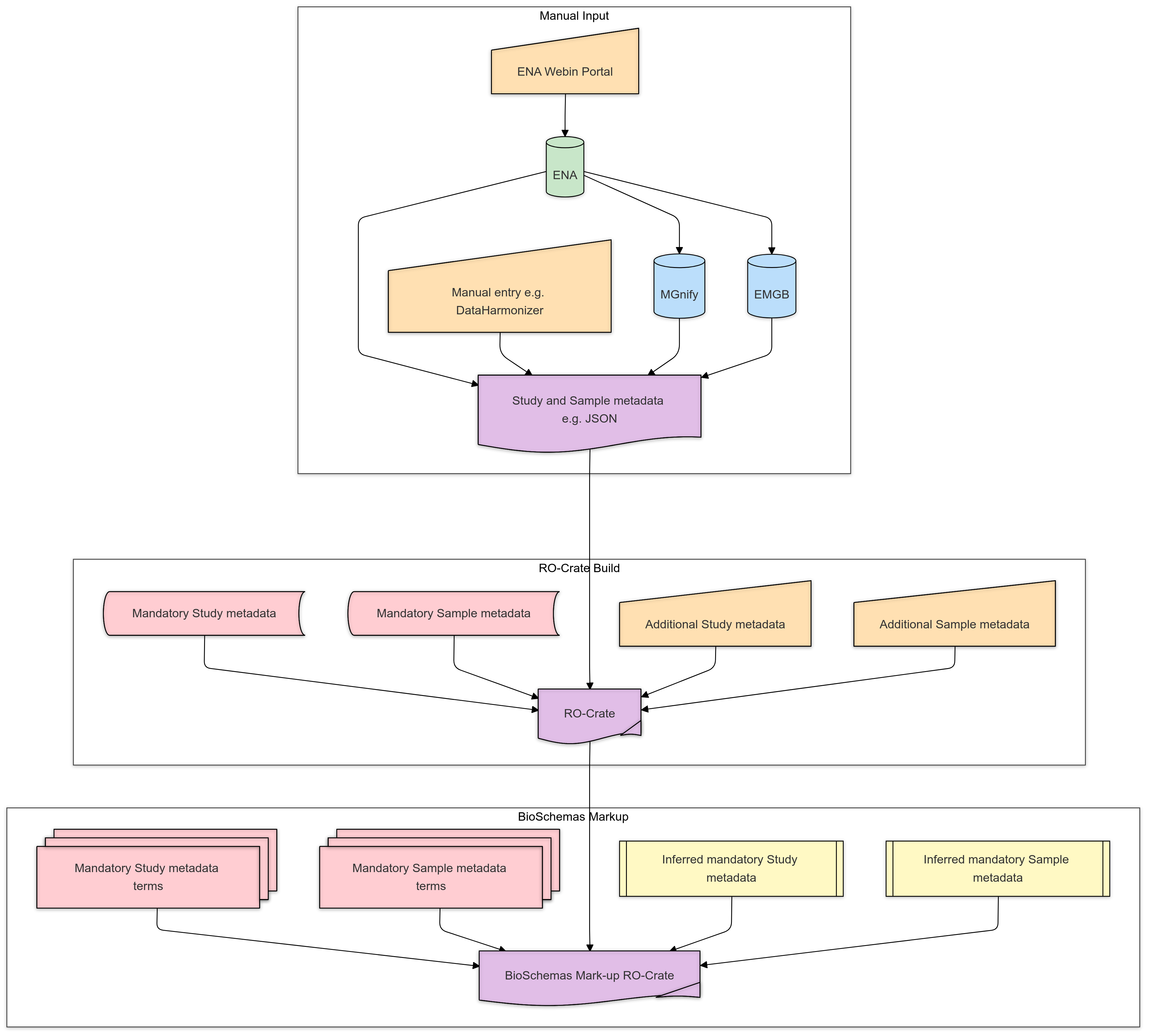
Schematic flow for how we envisage standardised metagenomic crates may be produced. Crate publishers would use variou...
Schematic flow for how we envisage standardised metagenomic crates may be produced. Crate publishers would use various means to input, store, and curate the metadata of their studies and samples, before perhaps building an “internally useful” RO-Crate. Finally, they would convert that into an RO-Crate of the specified format by mapping to the designated Schema.org and Bioschemas terms. Where mandatory metadata are not directly available, they may use methods to infer that metadata, for example using large language models (LLMs) on less structured metadata like free-text descriptions.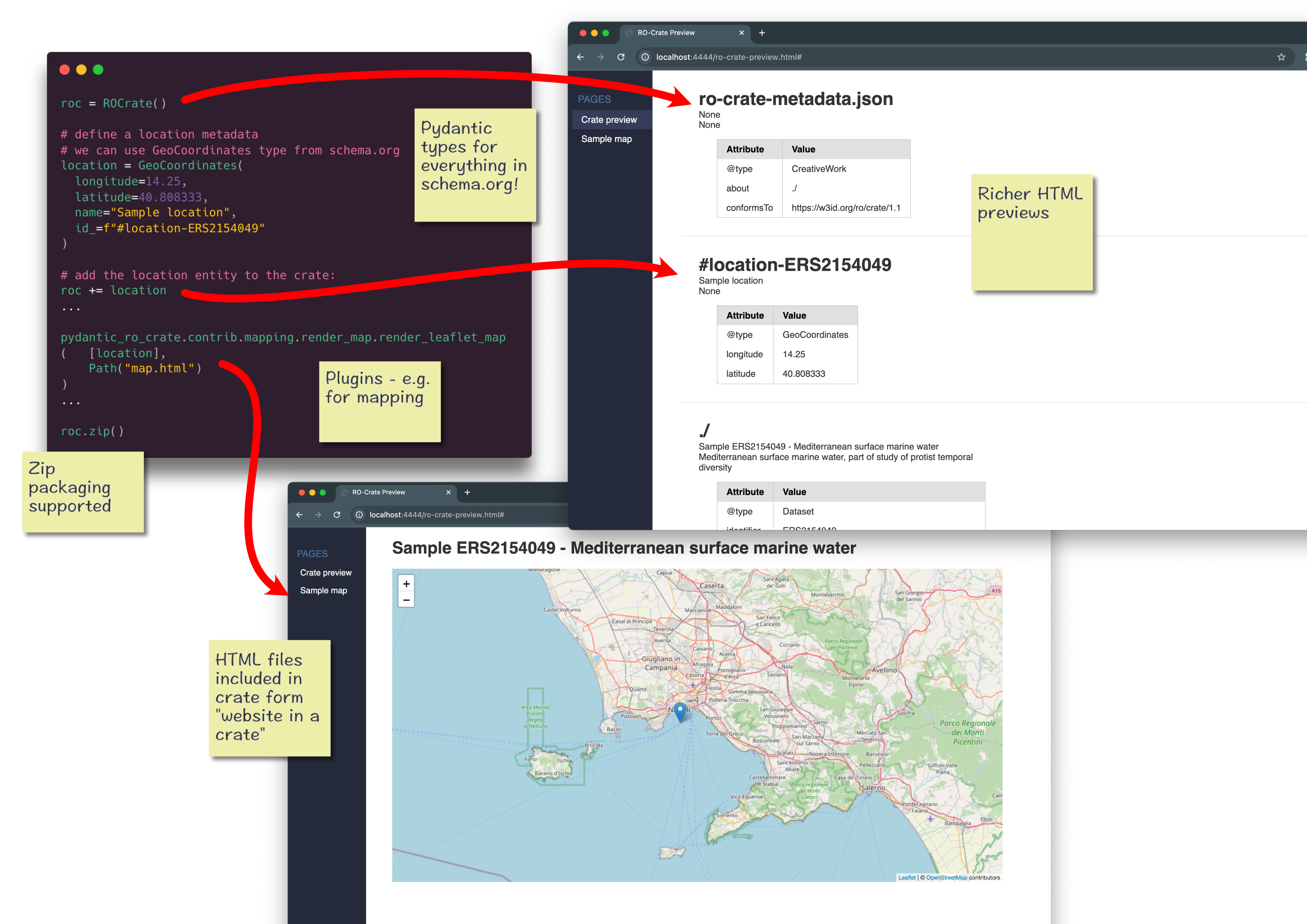
Composite screenshot summarising the features of the newly developed pydantic-ro-crates library. Pythonic code is use...
Composite screenshot summarising the features of the newly developedpydantic-ro-crates library. Pythonic code is used to construct crates from strongly typed entities corresponding to Schema.org types (or those derived from them). A plugin is available to construct HTML maps. Rich multi-page HTML previews are supported.
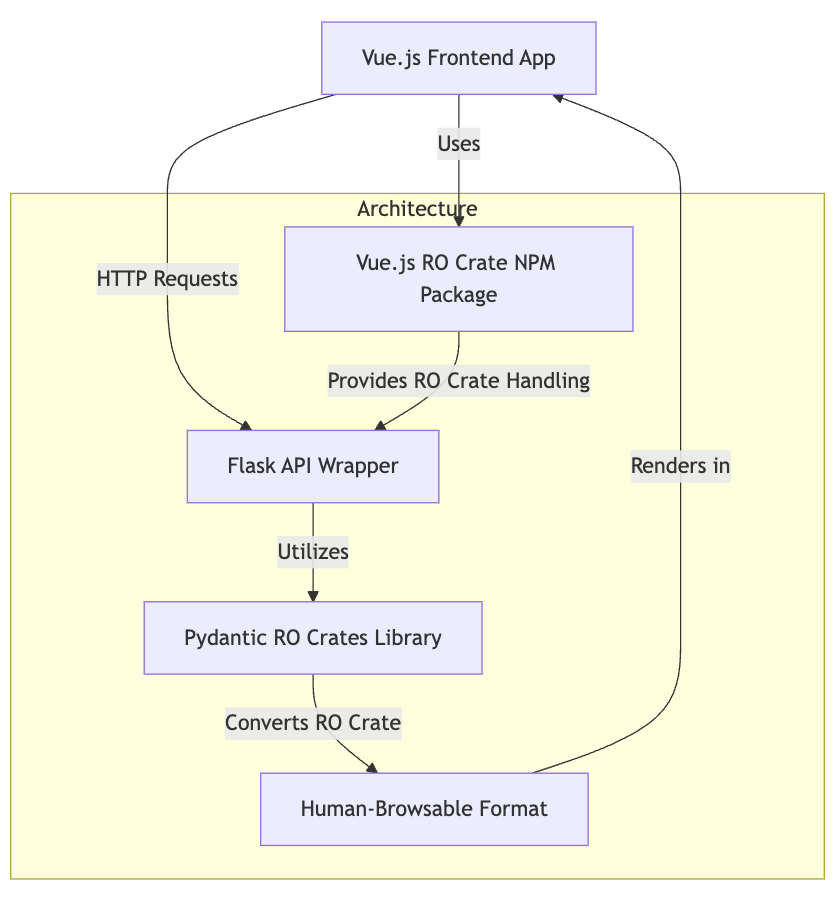
RO-Crate Browser
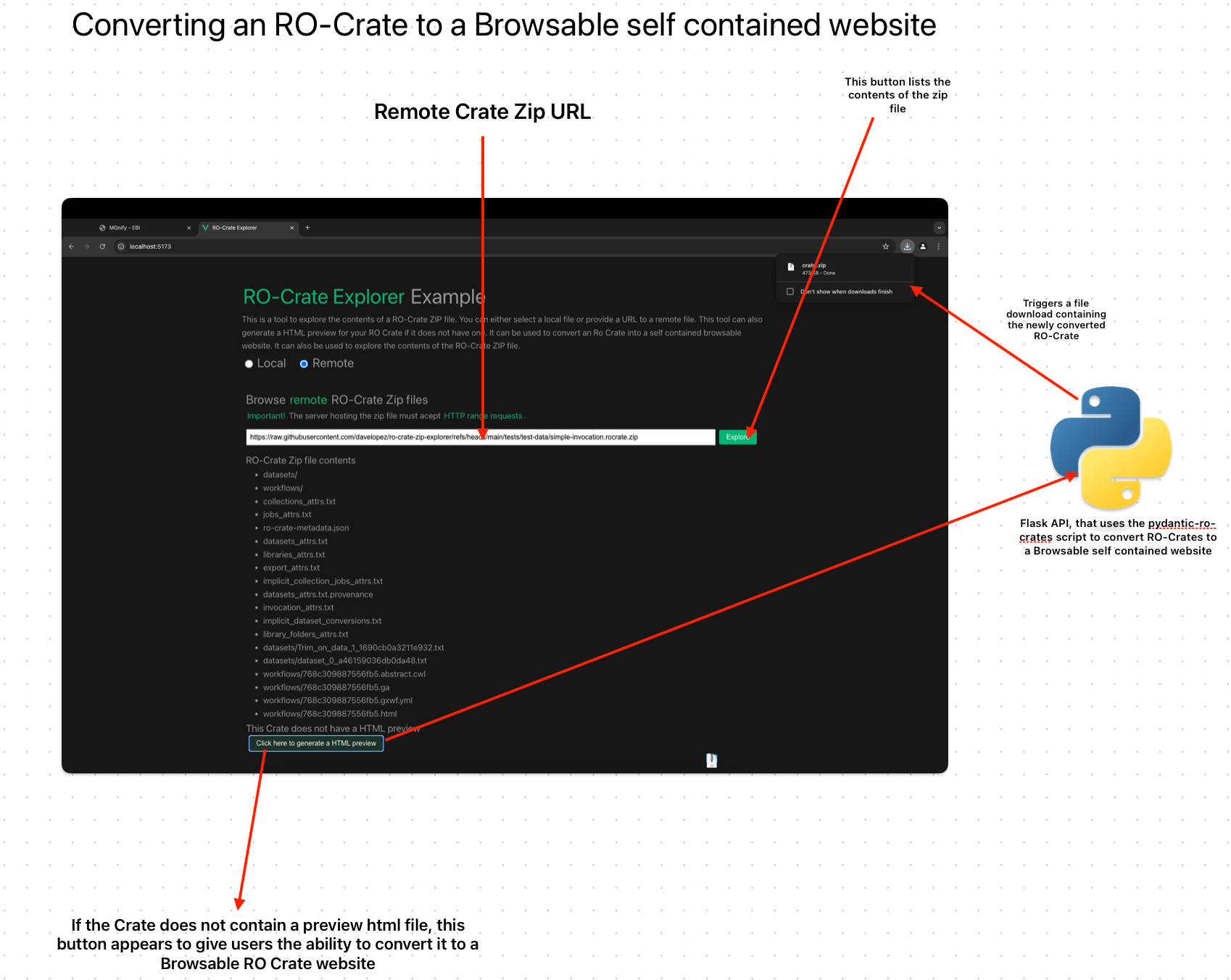
RO-Crate Browser
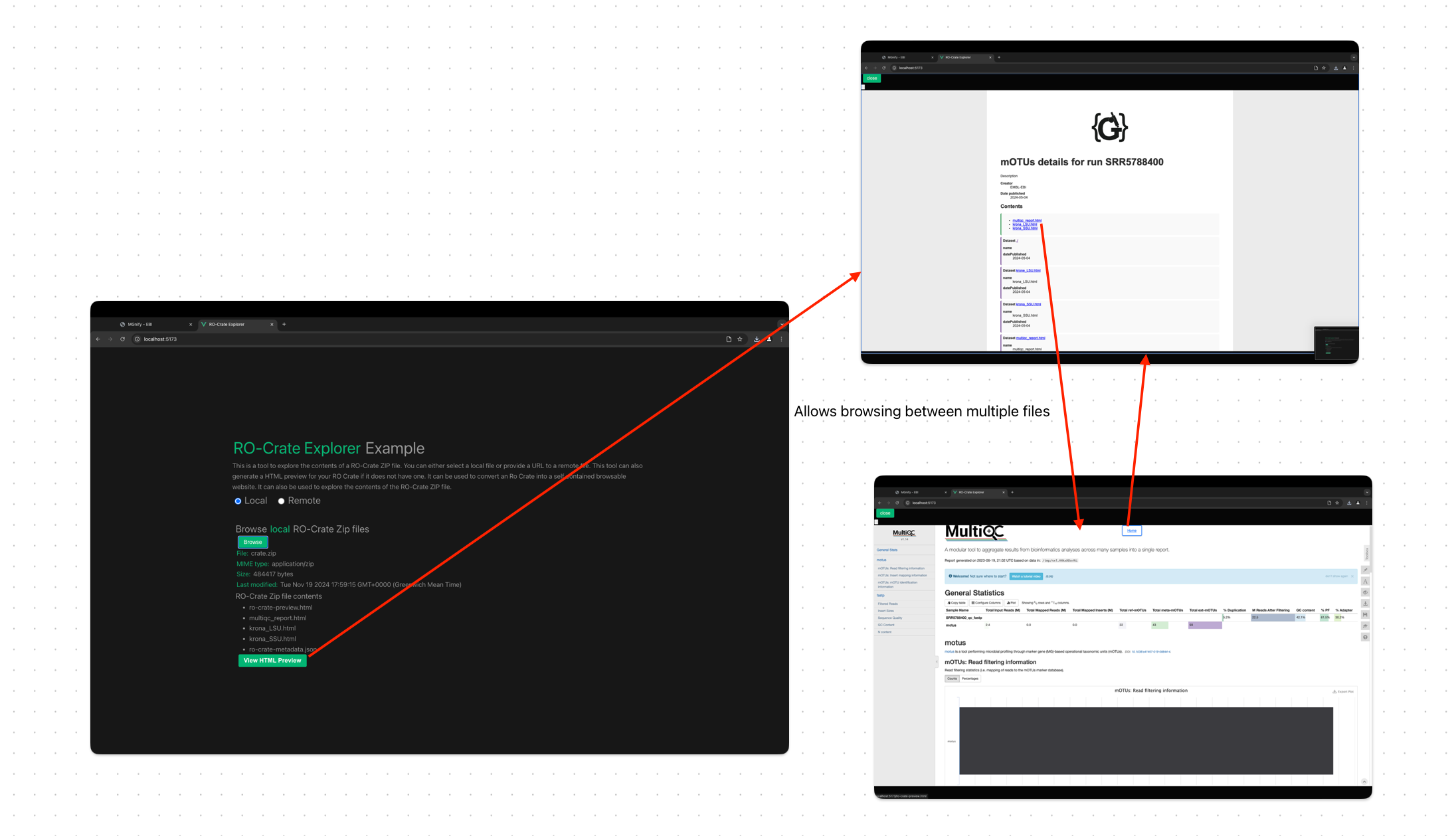
RO-Crate Browser