The Plant Breeding Ontology (PBO): towards an ontology for the plant breeding community
The need of standardizing the language used within a community has been recognized as one of the major components to enable a better integration of data as well as their further analysis. The plant breeding community makes use of a very specialized language, which has been evolving according to the new technologies and needs of their final users (e.g. farmers). That community is disparate all over the world. Therefore, a translation of the most common used terms has always been a key asset to accomplish their objectives as well as the ones of their collaborators. Here, we present PBO (Plant Breeding Ontology), an ontology for the plant breeding community which captures more than 2200 entries where 80 represent the core terms. PBO has translations in 8 different languages: English (main language), Spanish, French, Dutch, German, Japanese, Catalan and Thai, as well as their definitions, synonyms, derived terms and samples of their usage. PBO has been built partially manually and semiautomatically.
Figures
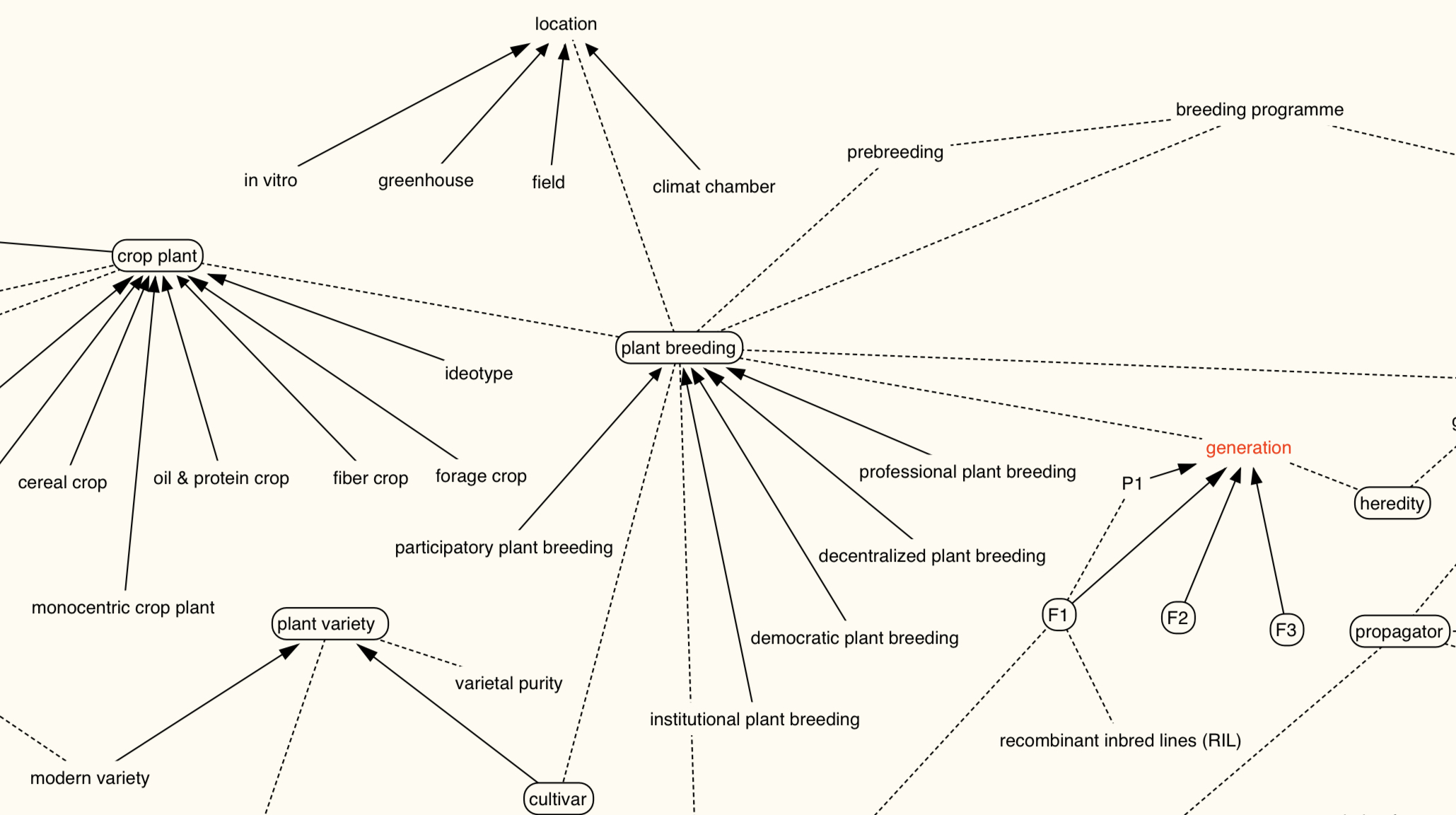
A small section of the entire Network of Concepts (NoC) showing a few nodes (e.g. plant variety) and their relationsh...
A small section of the entire Network of Concepts (NoC) showing a few nodes (e.g. plant variety) and their relationships. Solid arrows denote a hierarchical relationship. Dotted lines denote a non-hierarchical relationship. Encircled terms are part of PLABREGLO.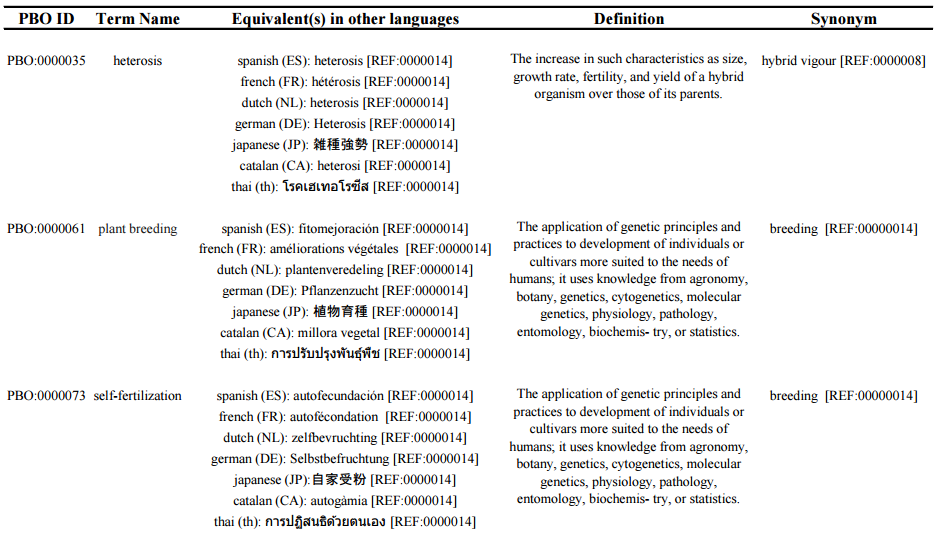
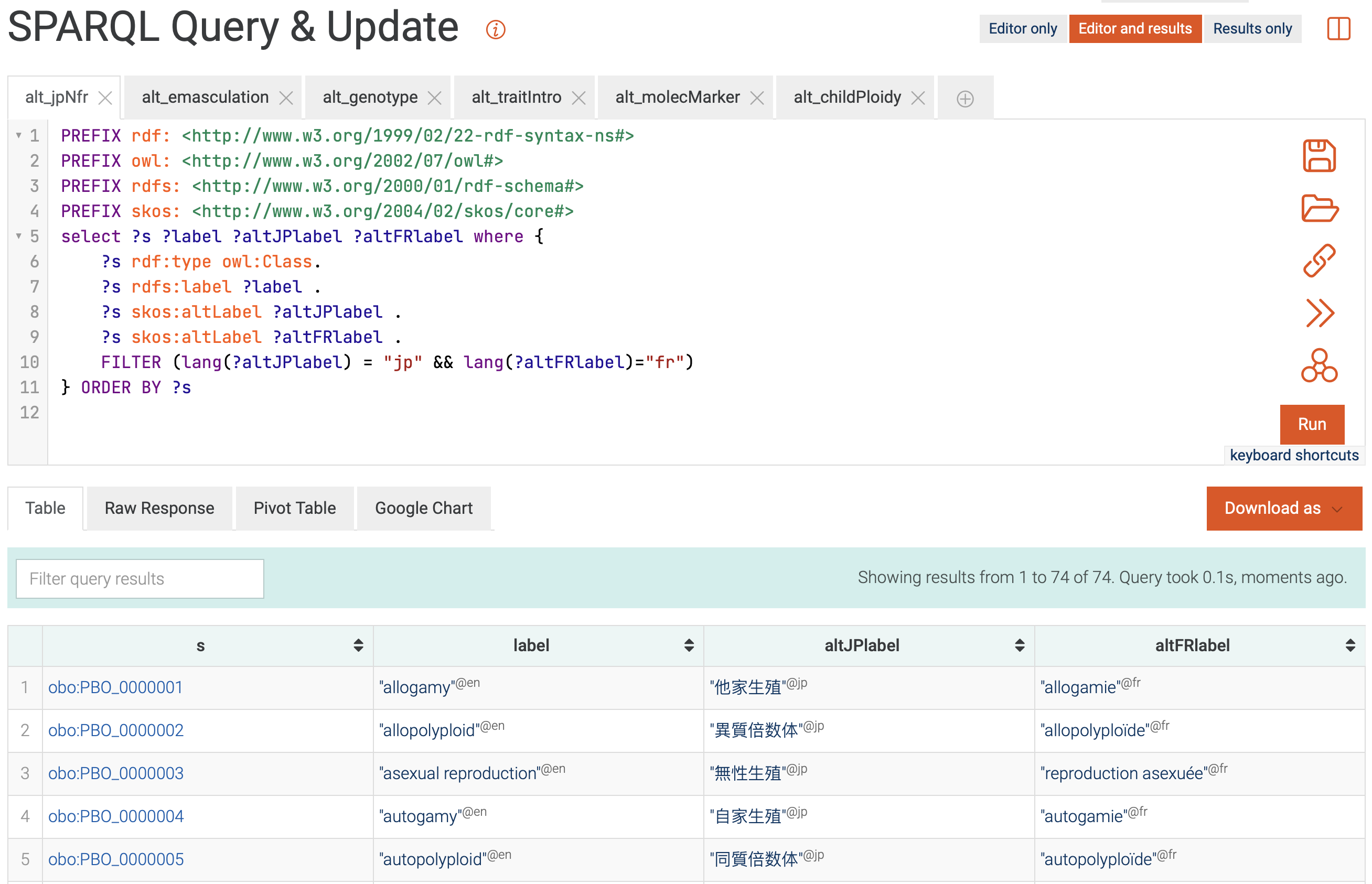
Example of a SPARQL Query and Interface Using GraphDB. This figure illustrates the SPARQL query editor and results in...
Example of a SPARQL Query and Interface Using GraphDB. This figure illustrates the SPARQL query editor and results interface of a SPARQL endpoint within GraphDB. The displayed query retrieves RDF classes with their labels and alternative labels, filtering for languages “jp” (Japanese) or “fr” (French). The query results are shown in tabular form below, listing unique identifiers, labels, and alternative labels for terms. This serves as an example of how queries can be constructed and executed in GraphDB. Additional example queries can be found in the appendix.